Percent Off vs Percent Increase: Why 50% Off Is Not the Same as a 50% Increase
Explore why a 50 percent decrease and a 50 percent increase do not cancel each other out, and learn how baseline reference values determine percentage math.
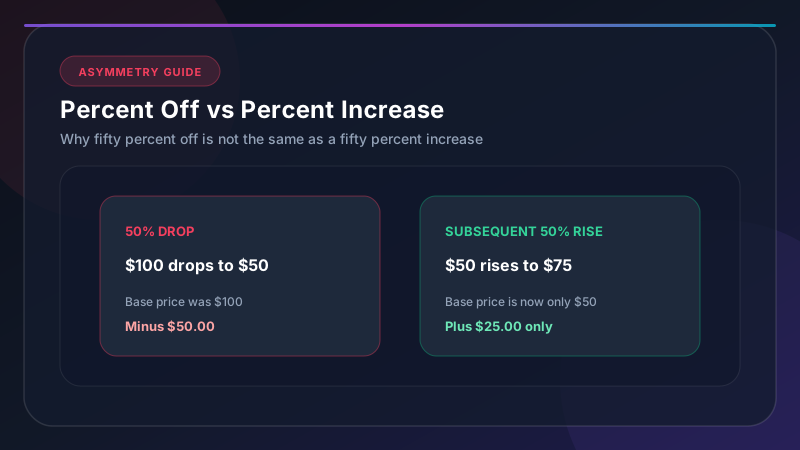
Percentages describe changes relative to a starting value. That starting point matters enormously. A 50% reduction and a 50% increase move in opposite directions and do not cancel each other.
What Is Percent Off?
Percent off describes a reduction from an original price or value. A 50% discount on $100 removes $50, leaving $50.
What Is a Percentage Increase?
A percentage increase adds a proportion of the original value. Increasing $100 by 50% adds $50, producing $150.
What Is a Percentage Decrease?
A percentage decrease measures how much a value falls from its starting point. Reducing $200 by 25% removes $50 and leaves $150.
Percent Off vs Percent Increase
The difference becomes clear through the starting value. A 30% reduction leaves 70% of the original amount. A 30% increase produces 130% of it.
Why 50% Off and 50% Up Are Different
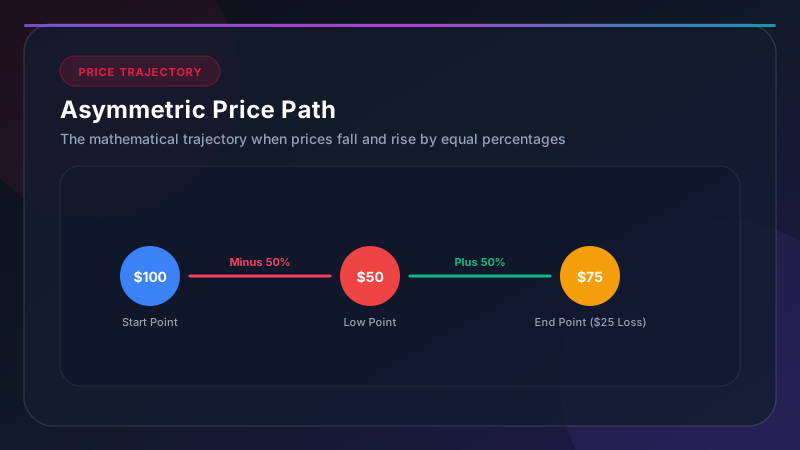
Suppose a $100 product drops 50%. It becomes $50. If that $50 price then rises by 50%, it becomes $75, not $100. The second percentage uses a different base.
How to Calculate Percentage Decrease
Use:
Percentage Decrease = (Original Value − New Value) ÷ Original Value × 100
If a price falls from $120 to $90, the decrease equals $30. Dividing $30 by $120 gives a 25% percent decrease.
How to Calculate Percentage Increase
Use:
Percentage Increase = (New Value − Original Value) ÷ Original Value × 100
A price moving from $80 to $100 increases by $20. That represents a 25% increase.
Understanding the Original Value
The original value acts as the reference point. Without it, a percentage change can become misleading. Always identify the starting number before performing a percentage calculation.
Real World Price Change Examples
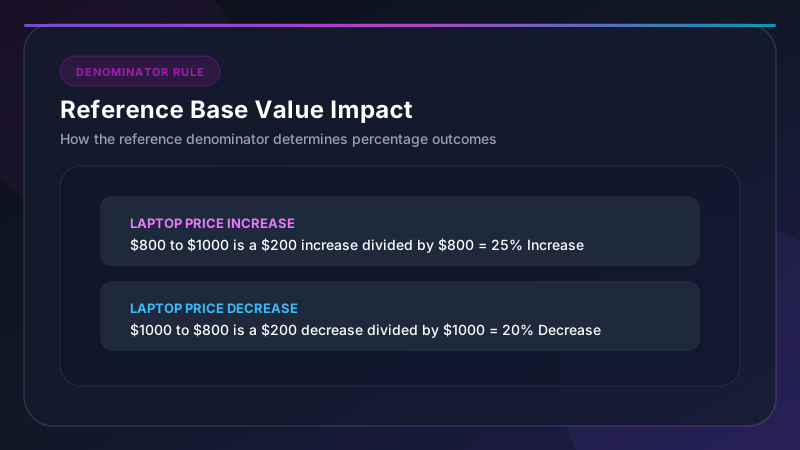
Imagine a laptop rising from $800 to $1,000. The $200 difference represents a 25% increase. If it later falls from $1,000 to $800, that decline equals 20%, not 25%.
Calculate Percentage Changes Easily
A percent off calculator handles reductions quickly, while a calculator designed for percent change can compare increases and decreases. These tools are useful when prices change repeatedly over time.
The crucial lesson is simple: percentages depend on their reference value. A discount, increase, and decrease may use similar mathematics, but their results can differ sharply.
Conclusion
A percentage decrease and percentage increase may use similar formulas, but they produce very different results. A 50% decrease does not cancel out a 50% increase because each percentage is based on a different starting value. Understanding the percent change formula makes price increases, discounts, and other percentage changes much easier to calculate correctly.