How to Calculate Percent Off: A Simple Guide to Discounts
Learn how to calculate percent off discounts, check store sales quickly, find exact savings amounts, and compute final prices before checkout.
Seeing “30% off” can make any shopping deal look exciting. But how much are you actually saving? Learning how to calculate percent off helps you check sales quickly. Whether you shop for clothes, electronics, groceries, or furniture, a simple discount calculation can reveal the real cost before checkout.
What Does Percent Off Mean?
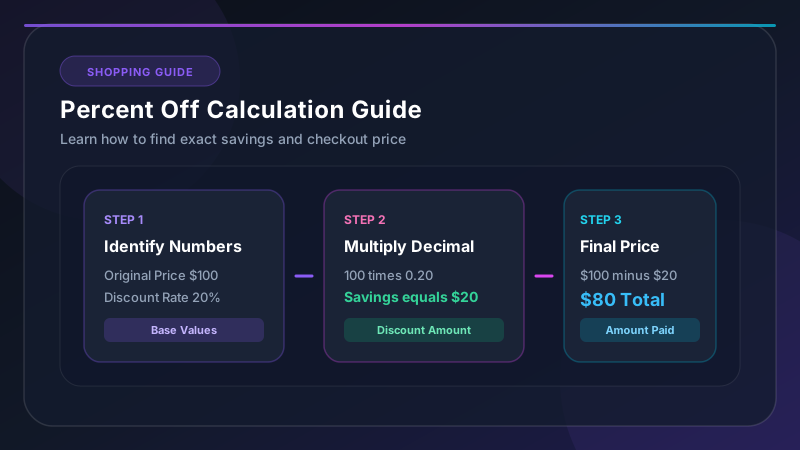
Percent off shows how much a store reduces an item’s original price. For example, 20% off a $100 jacket means a $20 price reduction. You save $20 and pay $80. The discount rate tells you the portion removed, not the amount you finally pay.
Understanding percentage off also helps you compare deals. A 50% sale sounds better than 20%, but the original prices matter. A 20% retail discount on an expensive item can sometimes save more dollars than 50% off a cheaper product.
How Does a Percent Off Discount Work?
A percentage discount follows a simple sequence. First, identify the original price. Next, identify the discount percentage. Multiply the price by the discount rate to find the discount amount. Finally, subtract the savings from the original price.
For example, a $150 television with 20% off gives you $30 in money saved. Subtract $30 from $150, and the sale price becomes $120. This basic process works for most ordinary sales.
How to Calculate Percent Off Manually
To calculate percent off, convert the percentage into a decimal. Then multiply it by the original price. For a $75 item discounted by 20%, use $75 × 0.20 = $15. The amount saved is therefore $15.
Next, subtract the savings from the original price. Here, $75 − $15 = $60. This discounted price calculation gives the amount you should expect to pay before applicable taxes or additional charges.
How to Calculate Percent Off Without a Calculator
Mental math can make shopping much faster. Ten percent means moving the decimal one place left. Twenty percent equals two 10% portions. Fifty percent simply cuts the price in half. These shortcuts make it easier to calculate discount amounts while comparing products.
What Is the Percent Off Formula?
The basic percent off formula is:
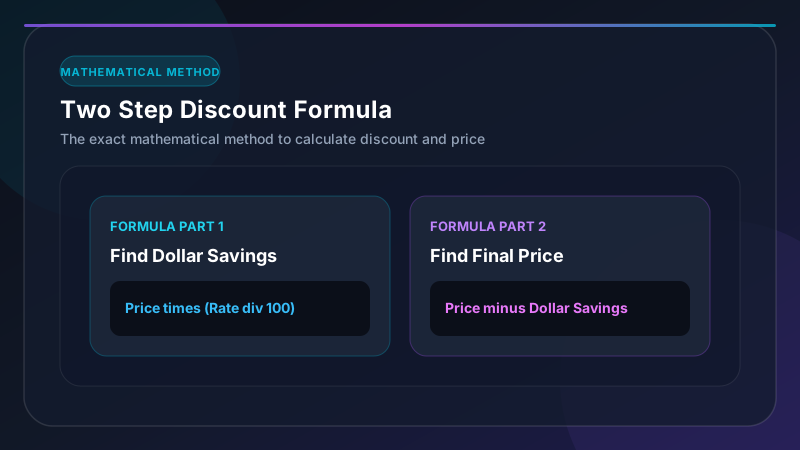
Discount Amount = Original Price × (Discount Percentage ÷ 100)
This discount formula first converts the percentage into a decimal. For example, 25% becomes 0.25. A $200 purchase therefore produces $50 in savings. The final price becomes $150.
How to Find the Discount Amount
Finding the discount amount tells you exactly how much money stays in your wallet. Multiply the original price by the discount percentage expressed as a decimal. A $90 item at 30% off saves $27.
This method also works with cents and larger purchases. For instance, 15% off $240 equals $36. Knowing the exact savings makes a shopping discount easier to judge.
How to Calculate the Final Sale Price
The easiest method is to subtract the discount amount from the original price. If a $120 coat receives a 25% sale discount, the savings equal $30. Therefore, the final price is $90.
How to Calculate Sale Price After Multiple Discounts
Multiple discounts require extra attention. A store offering 20% off followed by another 10% off does not usually mean 30% off the original price. The second reduction applies after the first reduction. Always perform each discount calculation separately.
How to Calculate 10%, 20%, 30%, and 50% Off
Common percentages become easy once the pattern is familiar. On a $100 item, 10% off saves $10, 20% saves $20, 30% saves $30, and 50% saves $50. The table below shows the resulting prices.
| Discount | Amount Saved | Final Price |
|---|---|---|
| 10% | $10 | $90 |
| 20% | $20 | $80 |
| 30% | $30 | $70 |
| 50% | $50 | $50 |

Percent Off Examples From Everyday Shopping
Imagine a $250 laptop with 15% off. The discount percentage equals 0.15, so $250 × 0.15 produces $37.50. The shopper pays $212.50 before tax. That gives a clear picture of the real percentage savings.
For another example, consider a $60 pair of shoes at 40% off. The savings equal $24, leaving a sale price of $36. These examples show why checking dollars saved matters more than trusting an impressive sale label.
Real World Discount Example
Suppose a furniture store marks a $900 sofa down by 35%. The discount amount equals $315. Subtracting that figure from $900 leaves a discounted price of $585. Shipping and sales tax may change the final checkout total.
Common Discount Calculation Mistakes
One common mistake involves confusing the savings with the final price. Another involves calculating the percentage from the wrong number. Shoppers may also add two successive discounts together. Careful use of the percent discount calculator method prevents these errors.
Sales tax creates another wrinkle. A listed discount usually reduces the taxable purchase price before applicable tax, but rules and promotions can vary. Always check the retailer’s terms when a large sale discount involves special conditions.
How a Percent Off Calculator Makes It Easier
A percent off calculator can handle the arithmetic instantly. Enter the original price and discount rate, and it can show the savings and final cost. A percent discount calculator becomes especially useful when comparing several products or unusual percentages.
For larger purchases, this tool can save time and reduce mistakes. A sale price calculator can also help shoppers compare competing promotions. Instead of guessing whether a deal is worthwhile, you can see the actual dollars saved.
Conclusion
Knowing how to calculate percent off turns confusing sale labels into clear numbers. Use the percent off formula, identify the discount amount, and subtract it from the original price. With a little practice, calculating savings becomes quick, practical, and surprisingly easy.